La foire aux ebooks sur Smashwords

Smashwords est une plateforme américaine d’autopublication de livres numériques qui présente, pour les auteurs et éditeurs qui y recourent, l’avantage de distribuer ses titres à de nombreuses autres librairies en ligne: Apple (iTunes), Barnes & Noble, Kobo, Fnac, Scribd, etc.

Chaque année en mars, Smashwords propose une semaine de foire aux livres dégriffés à 25, 50 ou 75 %, avec également de nombreux autres soldés à zéro. Une opération à laquelle participent des milliers d’auteurs, et qui se veut une « célébration globale des ebooks ». La « Read an E-book Week » se terminera cette année le 7 mars à minuit, heure de la côte Pacifique.

Read an ebookLa majorité des titres sont en anglais, mais il y en a dans de nombreuses langues, et en français bien sûr. J’y participe avec ma petite production:

La légende de Little Eagle, – 50 % Attention, à droite en haut: Use the code RAE50 at checkout for 50% off during our site-wide promotion! (Offer good through March 07, 2015)

Cougar Corridor, – 50 % Attention, à droite en haut: Use the code RAE50 at checkout for 50% off during our site-wide promotion! (Offer good through March 07, 2015)

The Legend of Little Eagle, – 75% Use the code RAE50 at checkout for 75% off during our site-wide promotion! (Offer good through March 07, 2015)

Un printemps sans chien, gratuit. A droite en haut: Use the code RW100 at checkout to get this book for free during our site-wide promotion! (Offer good through March 07, 2015


Share
Publié dans Edition et numérique, Lectures, Tout le blog | Marqué avec , , , , , , , , | Laisser un commentaire

Stories that connect and enlighten


About two weeks ago, I sent a paperback copy of my novel The Legend of Little Eagle to the Ninepipes Museum of Early Montana. I had thought that a story which was inspired by a letter I had found there should go full circle and get back there.

During the winter of 2000/2001, I traveled to the Flathead Valley of this Northwestern US State to do some research on mountain lions with field biologists. A novel on the issue of human encroachment on wildlife habitat, Cougar Corridor, was published in 2009 (in French) out of this wonderful experience.

I had fell in love with Montana but – living in Switzerland – I doubted I might ever return to such a remote place. One day, I stopped to visit the Ninepipes Museum, and there, somewhere between the photographs, artifacts, weaponry, old tools, and some paintings of Charles Russel, there was a letter written in 1947 by a French citizen from the region of Epernay.

It was addressed to the parents of an American pilot who had died in Champagne in1944. His name was LeRoy Lutz, and he had sacrificed his life by deciding to steer his P-38 Lightning plane away from a house he would certainly have destroyed had he bailed out a few seconds earlier. Lutz 2
On leaving the museum in Ninepipes, as I drove through the broad valley, surrounded on either side by the Rocky Mountains, I could not but think of that young pilot whot had left his family, this magnificent landscape, and a world at peace to enlist as a volunteer and go to risk his life on the other side of the ocean in a conflict which only indirectly threatened his country, the United States.

Could it be the beginning of a story, a hook for a novel ? The question went round and round in my head, but lead nowhere. It needed something to trigger it. And that something came to me one day in the form of another question : what if someone, in the present day, inherited the house the aviator had spared, and found out what had happend, which would signify a particular connection through time and space with that particular pilot ? And with that I knew I had found my story.

To this day, how the above mentioned letter arrived in Montana has never been clear for me. LeRoy Lutz was from Nebraska. But on his last day, he was flying the Lucky Lady, the plane of another airman, Arnold Helding, who was from Montana. Hence a confusion which lasted until the mid 1990’s, when LeRoy Lutz’s son, Richard, was able to be connected with the authorities of Mardeuil. He and his family were made citizens of honor of the town, which celebrates each year LeRoy’s heroic behaviour and tragic fate. When he learned about the heroic behaviour of his father, Richard said : « I was twelve when my mother told me that my father was killed in France. I had always thought he was the bravest pilot in the world. But now, I know it. »

Apart from the circumstances in which my hero, John Philip Garreau, dies (exactly similar to those in LeRoy Lutz’s fatality), there is nothing in common between the two of them in The Legend of Little Eagle, a pure fiction. But there are particular connections, through time and space, between this story and the historic facts. Some time after selfpublishing my novel, I found the phone number of André Mathy, a man from Mardeuil who – then 13 years old – had eyewitnessed Lutz’s plane crash, and who later spent decades trying to locate Lutz’s family. The day after the crash, Mathy had borrowed some tools from his uncle (or grandfather), who was a blacksmith, and removed the painting illustrating the name of the plane from its fuselage. He gave it back to Richard Lutz when he came to France. Mathy, aged 82 when I called him, was moved that I had found in Montana a letter he knew was written by a Mardeuil municipality officer.

In between, I had returned to Montana to do research in the archives department of the University of Missoula, and in Browning on the Blackfeet reservation, my hero being a very young Indian with a passion for flying who becomes a triple ace before dying the way Le Roy Lutz did.

As to Arnold Helding, he died in Montana in 2007 at age 92. Had I known then who he was and that he was alive, I could have met him there in Arlee, not far from the Ninepipes Museum. He lives on in my novel under the name of Harold Holding, a retired and USA Air Force that my narrator, Hélène Marchal, finds in Great Falls, a precious source when it comes to piece together the life of John Philip Garreau.

I’ve always loved planes but I’ve never been an aviation buff before undertaking this novel. Now I am filled with admiration for all those US airmen who volunteered (yes, volunteered !) to fight in order to free Europe from Nazism. And I find it wonderful, as I see my novel as a tribute to these young men, that fiction can meet history and revive it. A few French bloggers, like this one and this one have taken interest in The Legend of Little Eagle and written about LeRoy Lutz. Which proves that I was right in quoting William Kittredge, a Montana writer, on the meaning and importance of stories – why we need them, why they are important. A story is something which connects, which enlightens. It can also, sometimes, be a source of healing.

The Legend of Little Eagle was written and previously published in French under the title La légende de Little Eagle. It was translated recently by Alison Anderson. This novel is available as an ebook on the major digital bookstores and as a paperback on Amazon.

———————————————————————————————-

Florian Rochat is a French mother tongued journalist and writer living on the foothills of the Jura mountains in western Switzerland. A nature lover and a dog owner, he is fond of hiking and cross country skiing.

As an author, he has published two books traditionaly: La Saga du boulot (an oral history of working in France, out of print) and Cougar Corridor (a novel set in Montana about the sometimes conflictual cohabitation between people and mountain lions). Following The Legend of Little Eagle, he selfpublished Un printemps sans chien, about his relationship with his dog.

His website: http://www.florianrochat.com/index.htm


Share
Publié dans Aviation et pilotes, The Legend of Little Eagle, Tout le blog | Marqué avec , , , , | Laisser un commentaire

«The Memphis Belle » – 17 mai 1943 – Sortie de l’enfer


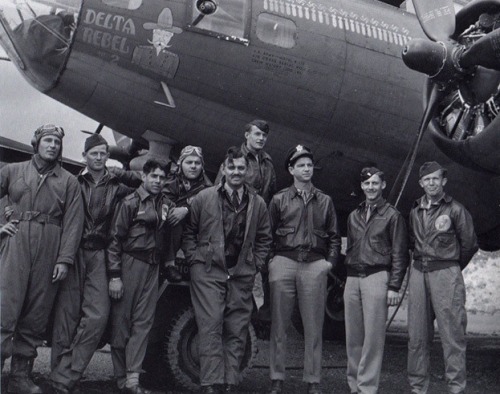
Le 17 mai 1943, l’équipage du «Memphis Belle », un bombardier B-17 de la 8e USA Air Force basée en Angleterre, accomplissait sa dernière mission: bombardement d’une base allemande de sous-marins à Lorient. Et il en est revenu, ce qui n’était pas garanti.

Cet avion est entré dans la légende de l’histoire de la guerre aérienne parce que son crew a été le premier à accomplir les 25 missions nécessaires pour être retiré du théâtre des opérations et pouvoir rentrer aux Etats-Unis. (Ce quota fut porté pas la suite à 30, puis 35 missions.)

www.libertyfoundation.org

Pour mémoire, cette année-là et jusqu’aux premiers mois de 1944, les B -17 étaient – en moyenne – abattus par la Luftwaffe et la flak entre leur 8e et 12e mission. En moyenne. Beaucoup n’en accomplissaient que trois, quatre ou six. Un grand nombre ne revenaient pas de la première. L’équipage comportait dix personnes. Certaines formations étaient composées de 1000 avions. Elles en perdaient parfois deux ou trois cents en un jour.

Ce qui faisait de ces aviateurs les combattants les plus exposés à la mort, après le personnel (beaucoup moins nombreux) des sous-marins. Dans l’infanterie, il y avait quatre ou cinq blessés pour un mort au combat. Chez les bombardiers, quatre ou cinq morts pour un blessé. Entre leur première mission en août 1943 et leur dernière, le 8 mai 1945, la quarantaine de groupes de bombardement de la 8e Air Force a perdu 4145 appareils. Exemples : 153 avions détruits en 324 missions pour le 94e groupe ; 159 pertes sur 314 missions pour le 384e, 189 sur 321 pour le 96e, 58 sur 195 pour le 398e, 33 sur 188 pour le 486e. Au total, les Etats-Unis (Boeing) avaient produit 12 731 B-17.

J’ai découvert l’histoire de « The Memphis Belle » en 1990 avec le film de Michael Catton Jones. C’est un film très honnête en ce sens qu’au-delà de l’hommage rendu à l’équipage de cet avion, il met en scène de manière réaliste tout ce qui pouvait leur arriver au cours d’une mission.

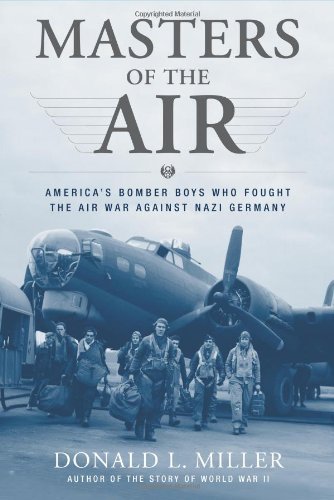
J’ai pu vérifier la justesse de cette synthèse en lisant l’extraordinaire livre de Donald L. Miller, Masters of the Air –malheureusement indisponible en français –qui raconte l’histoire de la 8e Air Force et la quête de la domination aérienne par les alliés en Europe. Ce livre fourmille de témoignages et souvenirs de pilotes, navigateurs, mitrailleurs, souvent hallucinants. Les combats contre la chasse allemande, les vols au milieu des obus tirés par les puissantes défenses antiaériennes du Reich, l’épreuve des vols en haute altitude, où les hommes récoltaient des gelures nécessitant souvent l’imputation, s’asphyxiaient parce leurs masques à oxygène se bouchaient, les dizaines d’avatars possibles à bord (moteurs réduits à néant, radio coupée, incendies), sans parler des balles de 12 mm. des Messerschmitt et des obus qui pleuvaient sur ces forteresses, tuant et blessant ses occupants. L’horreur, la peur et l’adrénaline à leur niveau maximum.

Les équipages des B-17, quand ils survivaient, ne tardaient pas à devenir un peu dingues et relever du traitement psychiatrique en urgence. Mais –incroyable – certains mitrailleurs, retournés aux Etats-Unis et s’ennuyant ferme dans leur nouveau rôle d’instructeurs, avaient rempilé pour un nouveau « tour » en Europe!

« The Memphis Belle », dans la version fiction de Catton Jones, met le doigt sur l’occasion de propagande auprès de l’opinion publique américaine que la réussite de son équipage avait représenté pour Washington. J’ai découvert deux autres film dans cette veine. Un du metteur en scène William Wyler, un documentaire également intitulé « The Memphis Belle » consacré à ses missions et à ses hommes, et un autre réalisé par l’acteur Clark Gable, « Combat America ».  Tous deux destinés à la propagande, entre hommage aux airmen et message aux Américains sur la nécessité du combat mené par leur pays.


Clark Gable avec un équipage de B-17

Ces deux stars de Hollywood ont effectué, chacun de son côté, plusieurs missions, à l’évidence au péril de leur vie, comme en témoignent leurs films. Paradoxalement peut-être, la mise en scène de Michael Catton Jones restitue de manière plus réaliste la nature de ces missions de bombardement que les reportages de Wyler et Clark.

Mais je vous invite à voir, et à revoir encore, les dernières minutes du document de William Wyler (depuis la 27e minute). Sur la base, les autres pilotes et membres d’équipage attendent le retour de mission d’une formation de B-17. Angoissés, ils comptent les atterrissages. Les ambulances foncent sur le terrain vers ces gros oiseaux troués de toutes parts, dont on se demande comment ils ont pu revenir, pour emmener les morts et les blessés… Les membres d’équipage rentrés intacts physiquement, mais hagards… Poignant.

Et enfin, le retour de « The Memphis Belle » (le vrai). Les spécialistes noteront que William Wyler, dans son film, se réfère -cartes à l’appui – à une mission de cet avion sur Wilhelmshaven, en Allemagne, qui avait eu lieu deux jours plus tôt que celle –ultime- sur Lorient. Mais peu importe. Heureusement tout de même que « The Memphis Belle » est rentré ce 17 mai 43. Dans le cas contraire, le film aurait passé aux oubliettes.

Dans la 8e Air Force, il y avait également des groupes de chasse, qui à partir du printemps de 1944 accompagnaient les B-17 dans leurs missions de bombardement. « La légende de Little Eagle », un roman évoque la vie de ces « fighters ». In English: « The Legend of Little Eagle ».


Share
Publié dans Aviation et pilotes, Tout le blog | Marqué avec , , , , , , , | Laisser un commentaire