![Pageflex Persona [document: PRS0000039_00075]](http://www.florianrochat.com/wp/wp-content/uploads/2014/04/Cover-LE-English.jpg)
« The Legend of Little Eagle » is a novel translated from the French. It’s on sale on Amazon.com, Amazon.co.UK, Amazon.ca, and Amazon.com.au, as well as on Smashwords as en ebook. It will soon be available on other major digital bookstores as an ebook and as a paperback on Amazon.
Prologue
“There they are! At two o’clock, altitude roughly 20,000 feet,” said the flight commander.
As they began a slight descent, the five squadrons of twelve planes swerved to the right to position themselves in the wake of the eighty flying fortresses whose mission that day, March 16, 1944, was to bombard a munitions factory near Hanover. The linkup between the fighter planes and the bombers, which had taken off from different bases in the south of England, had been effected as planned at 8.45, above the North Sea and within sight of the Netherlands.
John Philip Garreau felt his pulse begin to race at the thought he would soon be in German airspace. He thought of his parents and his friends. He thought of Jeff Thorsen, his mentor, to whom he owed so much. “Here we are,” he thought. The trial by truth. The baptism of fire. War. He would find out whether he had what it took, or whether—like so many others—he would be killed on his first mission: these questions crossed his mind, but he banished them effortlessly, so intense was his concentration. He had to follow the course the group leader had set, and he in turn was followed by the leader of each squadron, until they had all positioned themselves above and around the B-17 flying fortresses which the brand-new P-51 D Mustangs had been assigned to protect from the German fighter planes.
Back at base in Metfield in Suffolk, the pilots of the 353rd fighter group of the 8th American Air Force had got up at half past five. They had a quick cold water wash at the sink in their billet. Some of them had shaved, to avoid the abrasive effect of the oxygen mask on rough day-old stubble, but most of them had done it the night before, just before bedtime. They put on their flight suit—flannel shirt, woolen sweater, long underwear, padded trousers, lined boots, leather jacket lined with sheepskin, not to forget the indispensable silk scarf. They would be moving their head thousands of times—left right, up down, back and forth— and were it not for the square of silk, their leather helmets would rub the skin on their neck to shreds after the five or six hours of flying that lay ahead. Then they’d gulped down a frugal breakfast of black bread and marmalade with tea or ersatz coffee—nothing like the plates heaped with omelets, sausages, and pancakes of their American breakfasts. England was subjected to severe rationing, and they were only entitled to one egg a month, almost no meat, a little bit of dairy produce, and a lot of Brussels sprouts. Nearly all of the men who’d been there longest had lost a few pounds.
Then they’d gone to the base briefing room, where the colonel who was head of operations had prepped them for the day’s mission. At 7.30, after urinating to avoid the discomfort of a full bladder at high altitude, they were out on the tarmac, where their mechanics helped them put on their harnesses in the narrow cockpit. They had their parachutes on their backs, their Mae Wests on their torsos, their self-inflating dinghies beneath their buttocks, their helmet radios switched on, and their masks hooked up to the oxygen tanks. They’d revved up their 1700 horsepower motors, let them heat up for ten minutes, and then they took off.
During the mission briefing John Philip Garreau sat in the last row, impassive. While he listened to the officer, he looked at the other pilots with a mixture of curiosity and admiration. Most of them had already seen combat, and some of them had at least one victory under their belts. “No, they’re no different from me,” he tried to convince himself. “They have fighting experience, and yet they began the way I did, as good pilots, but who’d never gone to war. And now they’re still here, and sometimes it’s been several months. Some of them must be aces, with at least five swastikas painted on the fuselage of their plane. They’ll be going back to America before long…” Those young men were between the ages of nineteen and twenty-five, most of them between twenty and twenty-three, and they paid absolutely no attention to this newcomer who had just celebrated his eighteenth birthday one month earlier. Not a single one had anything to say to him, not even hello. John Philip Garreau felt they were somewhat condescending toward him, and he understood that he needed a few missions under his belt, and a few replacements would have to arrive in the group, before he would be admitted into what seemed to be a very select club, whose members had been through something that set them apart from the common of mortals: the ordeal by fire.
Now Richard Johnson, a twenty-two-year-old captain who would be leading the formation he belonged to, came up to him.
“Welcome, Lieutenant Garreau. I just have to tell you that this mission might be difficult and dangerous,” he said in a neutral tone. “Of course all of them are, but some less than others… Today we can be sure that the Jerries will do everything they can to get us and try to shoot down the fortresses before they reach their goal. That’s their job. But ours is to fight to win the war, right? I have faith in you,” he added, patting him on the shoulder. “So I’m not going to give you any advice, or tell you all over again what you already learned during training. But I just have two things to point out: discipline and team spirit. That’s the most important thing of all. If one of us forgets it, the others are in danger of getting killed. And one more thing: the Army has done everything it could to give you the best possible training, and if you are here, it’s because you’ve met the grade. And right this minute, you have to be aware of the fact that nothing has yet truly prepared you for aerial combat and everything it implies. Simply because it’s impossible to be prepared. No one can be prepared.”
John Philip Garreau had a good idea of what the captain meant. The speed, violence, and anarchy of those mortal battles in the blue. The decisions—right or wrong—you would take in a fraction of a second, depending on random developments that might have nothing to do with situations you had studied or tactics you’d been taught. And the absolute, constant necessity of anticipating the enemy’s actions, and of thwarting any enemy reaction to their own actions. The wildest maneuvers, sometimes at the limits of the airplane’s resistance. Sudden climbs, swerves as tight as could be which caused the aircraft to vibrate. Vertiginous nose dives where the pilot’s blood, under the effect of the acceleration that increased his weight up to six times, accumulated in his lower body and no longer flowed through his brain. The dreaded black veil that would blind a victim for what seemed like endless seconds, leaving him terribly afraid. The physical effort it took to pilot these fighter planes, whose controls had no hydraulics, was intense, sometimes at the limit of what was possible. Johnny could also imagine the panic he would surely feel if his plane were hit by the enemy, and how horrible it must be to watch a comrade go down in flames. Air combat was exciting and terrifying. According to an ace from the Pacific who had come to share his experience on an American base during Johnny’s training, some pilots would vomit or soil themselves during the flight.
John Philip Garreau nodded gravely and said, “You can count on me, Captain.”
“Good, Johnny, call me Rich. Our job is already hard enough as it is without having to worry about rank,” concluded Johnson, thumping him on the back before heading over to his plane.
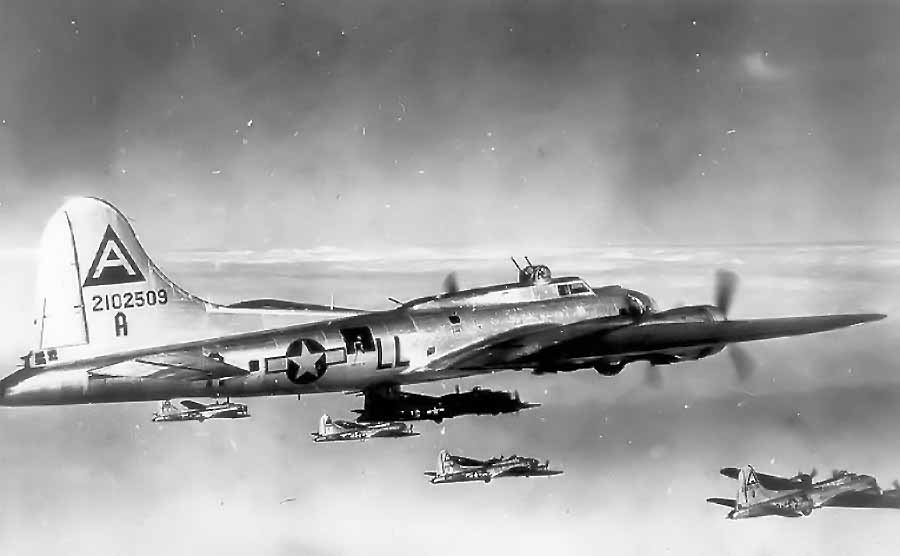
In groups of four, the Mustangs flew in V formation above the squads of bombers in order to ensure constant cover. Flying a hundred and fifty feet or so above a B-17 that was slightly to his right, Johnny observed the giant plane he was seeing in flight for the first time. He was impressed by the mass of the four-engine craft that weighed up to thirty tons fully loaded and which had thirteen machine guns for its defense against predators in the sky. The guy manning the twin guns in the turrets located above the cockpit gave him a friendly wave, and he responded with his left hand.
None of these machine gunners had fired at the fighters when they came near the B-17s, which was already a good thing, thought Johnny.
Like everyone, he had heard that those guys knew that their missions had a lot in common with Russian roulette, and that they themselves were very vulnerable to attack, so they were trigger-happy. The flying fortresses, in fact, had nothing of a fortress about them except the name. Their size and slowness made them vulnerable, and their gunners, as a precaution, frequently fired on any plane in the proximity before they’d even been able to identify them. A considerable number of allied pilots had been shot down by those they were supposed to protect. But it was during the combat taking place around them that the gunners were most dangerous. Trapped in their protruding Plexiglas turrets, which they could pivot by means of pedals in order to confront the enemy from different angles, they had to shoot to protect their plane, but everything went so fast that sometimes they couldn’t help it: often everyone got hit. Fighter pilots from their own side would curse them, but they couldn’t hold it against them.
The fighter pilots liked to think of themselves as the aristocracy of aviators, the equivalent of virtuosi racing car drivers, whereas the men who were at the controls of the bombers looked a bit like truckers to them. The fighters claimed they were winning the war, with a ratio of several victories on their side to one for the Luftwaffe in their duels in the sky. But beyond their ego they had respect and admiration for the men who made up the crews of the B-17s, who were equally convinced that it was their bombing raids that were bringing the Allies closer to victory, by destroying the Reich’s industrial capacity.
The fighter pilots were also aware of how courageous the crews had to be when they came in sight of their goal—if they hadn’t already been shot down by the German fighters, that is. The fortresses’ sighting system obliged them to fly for ten minutes or so straight at their target, through a lethal barrage of flak, hundreds of black snowflakes of shells, neither changing course nor altitude, and without the protection of their “little friends,” the P-51s who were required to fly back to base. And the price to pay was terrible: on average, a bomber was shot down after ten or twelve missions. On average. A few managed to hold out a bit longer, many were destroyed between their third and their eighth sortie. There were ten crew members on board. Some died in the flames, caught or injured in the cabin. Those who bailed out by parachute were almost always captured by the Germans. The crews had to fly twenty-five missions before they could be repatriated to the States. The most incredible thing was that some of the miraculous survivors who made it home actually joined up again after a month of paid leave.
Lieutenant Garreau knew all this. He also knew that because their missions were so very dangerous, before departure the bomber squadrons and their crews were often blessed by an army chaplain. One of them—a New Yorker of Irish origin—was well-known, and much-loved for the little phrase he would utter right at the end of his speech, after “Blessed be the Lord, may he go with you as you fulfill your duty, and may he enable all of you to return safe and sound. Amen.” Then he motioned to his flock to draw close in a tight circle and murmured, “And give ’em a damn good licking!”
Another plus that morning: the flight conditions—clear skies, not much wind—were good. At least they’d be spared the frequent drama of flying through fog or thick cloud cover, when a B-17 would climb a few feet only to collide with another one from underneath or clip its wing. Frequently both planes would explode in flight or go into a tailspin.
The young pilot felt as if he were one with his brand new P-51 D Mustang, held to be, along with the German Focke-Wulf 190, the best fighter at the moment. Just before embarking on a cargo ship for England a few weeks earlier, at the end of his training stint back in the States, he had broken his plane in, and its performance had filled him with enthusiasm. Four hundred and thirty miles an hour, flying horizontally at just over twenty-one thousand feet, up to five-hundred and sixty in a dive. Six Browning 12.7mm machine guns. A powerful rate of climb. Service ceiling 41,900. Its panoramic canopy was a vast improvement as far as visibility went, compared with the previous model. Very easy to handle, not to mention an autonomy of eighteen hundred miles, thanks to two releasable seventy-four gallon fuel tanks located beneath the wings. It was this specification more than anything that had allowed the Eighth Air Force to modify its bombing strategy over Germany, which initially had been undertaken only at night. Since December 1943 the number and frequency of bombing raids had increased, thanks to the P-51s, which could escort the fortresses by day over the entire German territory before returning to base, and limit the carnage the German fighters could inflict on the formations of vulnerable bombers.
www.grissomairmuseum.com
The only thing that worried John Philip Garreau was the position he’d been assigned in the formation: tail end Charlie. Last in line. This was the lot of newcomers. But it was the hardest spot to occupy, because the pilot was obliged to show his prowess by maintaining his position in the turbulence created by those who were in front of him, or by reacting swiftly to a sudden change of course ordered by the leader. It was also the most dangerous position: when the enemy were attacking, they generally preferred to do it from behind, and the Charlie who was at the tail end of his group was often the first victim; sometimes the comrades flying ahead of him did not even realize he’d been hit.
After they’d flown past Amsterdam without meeting any resistance, the fleet continued on its way, due east for Hanover, flying at roughly eighteen thousand feet. All the pilots were peering at the sky in every direction. But the air space still seemed empty.
Suddenly John Philip Garreau’s voice resounded over the radio.
“Red Four here. Unidentified aircraft at three o’clock. Same altitude.”
“Huh? Where?” said one pilot worriedly.
“I don’t see anything!” said another.
“I don’t see anything either,” said Major Lester Brown in a neutral voice; he was in the head squadron over half a mile away, in charge of the mission, and he was supposed to spot any enemy formations.
“Are you sure of that, Garreau?” asked Richard Johnson.
“Confirm. Thirty planes at least.”
A tension-filled silence settled over the radio circuit for a good minute. Then Brown’s voice came in:
“Blue Leader here. Confirm. Estimate thirty miles, minimum.”
“Fuck, he’s got incredible eyes, that Garreau!” exclaimed someone else.
John Philip Garreau had detected the enemy approach, a tiny swarm of insects, from over fifty miles away.
Brown immediately decided on the tactic: maneuver in such a way as to prevent the enemy aircraft—initially at least—from approaching the bomber formation, in order to protect the bombers while preserving the space necessary for engagement.
“Okay,” he said. “Red Flight, Yellow Flight and Green Flight, go with Blue. White, stay with the fortresses.”
All the pilots jettisoned their extra fuel, because it would hamper them in combat. The leader swerved to the right, rapidly gaining altitude to reach an interception position, while placing his back to the sun. The sixty planes he was leading were now flying full throttle, the motor feed set on the richest mixture, machine guns unlocked.
With his right hand on the joystick, index finger on the trigger, and left hand on the throttle lever, John Philip Garreau felt his P-51 tremble as the Merlin motor was unleashed. He was one with his plane, he knew he could master it under any circumstances, in flying conditions where instinct would have to prevail over everything else.
The pilots of the Messerschmitt 109s had sensed the danger, and they had also changed course so they would be ready to meet their attackers before the Americans acquired any real advantage. Suddenly both formations were rushing at each other, and the combat began. Discipline worked when the group leader had enough time to deploy his men in different directions, in order to fragment the battle and coordinate the action. But in this case it was every man for himself. Which did not mean there was no team spirit, that a pilot would not intervene whenever possible to help a comrade in difficulty.
The German pilots were extremely aggressive. The planes from both sides flew past one another, mutually intersecting their flight paths in every direction, attacking, withdrawing, zigzagging to find the best firing angle. The Americans’ radio channel was an endless succession of shouts, “Bill, Kraut at four o’clock!”, warnings, “Ed, get out, to your left!”, “Ken, watch your ass!” or calls for help in desperate flight: “I’ve got a Jerry up my backside and I can’t get rid of him!”
His thoughts racing at the speed of light, John Philip Garreau wondered if anyone could really react to these interjections, and why there had not yet been several collisions in this incredible melee. He recalled the basic rules of flight combat: whenever possible, have the sun at your back when attacking; constantly look around and behind you; never fly more than thirty seconds horizontally—that gives your adversary time to take aim at you; carefully look behind you when you come out of a cloud: if you’re unlucky, you might be right in front of a Kraut, giving him the easiest target of the day.
He suddenly saw a Messerschmitt bank tightly, to his left and slightly above him, aiming his fuselage in his direction. Just as he pushed the joystick forward to evade him in a dive, he saw tracer bullets go by six or eight feet above his canopy. He swerved hard to the left before going into a loop roughly six hundred feet from there, just as the German was in the process of turning around to come back for him.
When he flipped onto his back to dive down at the end of his climb, he caught a glimpse of a pilot going down by parachute, but too quickly to see which side he belonged to. Starting his dive, he glanced behind him to make sure there was no danger and a bit further down he could see his assailant maneuvering to escape the Mustang’s plunging trajectory. There were still more aircraft above, below and all around, but where he was the space had been partially cleared, for a few seconds at least. Full throttle, making the most of the increased speed his angle of descent was giving him, he rushed at the Messerschmitt, which was almost opposite him, but just when the firing angle seemed ideal, roughly 1200 feet from his target, he concluded that he was too far away to fire effectively.
As for his adversary, he was expecting the American to take pot shots at him, because he interrupted his trajectory, banking ninety degrees to go into a large circle that would enable him to reposition himself. Lieutenant Garreau reacted by changing direction: he nosed his P-51 up in order to climb roughly nine hundred feet. He applied the left rudder bar to cause the aircraft to swing into an almost vertical position, as if he were pivoting around his tail, and to go into a dive in the opposite direction from the one he had chosen when beginning his maneuver.
Once again the Messerschmitt was just opposite him, slightly lower down in the same axis, but with its back to him, so he could not fire on the Mustang. Nine hundred feet… seven hundred and fifty… six hundred… John Philip Garreau held the trigger for three seconds, then splattered the enemy plane over its entire length before straightening up to fly well above the German. Further along he turned and then he saw the Messerschmitt in a spin, its engine on fire. The pilot must have been killed by the hail of bullets; he wasn’t bailing out. Thrilled by this first victory—which he would ratify on his return thanks to the pictures from his new gun camera—John Philip Garreau watched the enemy airplane for a few seconds as it fell, then he straightened up and looked all around him for a new adversary.
He found one flying slightly to one side of the ongoing melee, and he maneuvered to try and surprise him in a position of weakness. The other plane managed to evade him, forcing his assailant to try a different approach, a different tactic. “Andrews, Green 2. My engine is spluttering. I’m going back!” he heard on the cacophony of the radio. In the constantly shifting battle of the skies, Garreau suddenly found himself opposite a Mustang under side attack from a Messerschmitt from the side, one of Blue Flight’s planes. “Attention Blue 3! At four o’clock!” shouted Garreau, who didn’t know the name of the pilot he was warning. Too late. He saw white smoke coming from the belly of the P-51, from the rear of the fuselage where the glycol radiator was housed, containing the engine’s cooling fluid; now in only a few minutes it would seize up. The pilot went into a half roll and jumped.
John Philip Garreau cleared out, then turned to come back to the Messerschmitt, whose pilot seemed unaware of him as he hunted for a new position and a new target. From a distance of roughly 1200 feet, firing blind, Garreau let out a hail of bullets, and the enemy opted to flee into a dive, a tactic that was often dissuasive to the pursuant because it was so trying on the nerves. But when Garreau saw the white corolla of the Blue Flight pilot’s parachute, he did not want to let the attack go unpunished. He followed the Messerschmitt in its dizzying dive toward land and got as near as 600 feet. The two fighters were flying full throttle and their speed was about to surpass the limits of their flight envelope. Anything beyond meant disintegration, pure and simple.
The pilot of the Mustang concentrated, to position the Messerschmitt’s tail in his sights, but it was getting very difficult to control his aircraft and shoot at the same time. The structure was beginning to vibrate throughout. He tried all the same, letting out a few bursts of fire, and he had the impression that the German plane had been hit, but not damaged, because it was continuing on its terrifying descent in a perfectly mastered trajectory. In no time at all the two planes had dived from 18,000 to 6,000 feet.
Of course John Philip Garreau had tested his Mustang in a dive, but never over such a distance. He had his eyes glued on both his prey and the ground, which was coming closer at a terrifying speed. It felt as if his body weighed a ton. Clearly the German hoped the American would crack in this suicidal pursuit, and he had to force him to it by maintaining his dive until the very last moment. Three thousand feet, fifteen hundred, nine hundred… You would have to be an ace to straighten up your plane, flying that fast at such a low altitude. The German tried to zoom but he started a second too late, and as his peers the world over would say in similar circumstances, he dug a big hole in a field.
John Philip Garreau had had the foresight to pull on the joystick just before what he thought must be the last second, but he only started climbing again 150 feet from the ground. It was as if someone had put a black veil over his eyes. For a few seconds, he flew haphazardly, erratically, plunged in an anxiety that was almost impossible to overcome. Then gradually his vision returned. Once he had regained some altitude and stabilized his plane in horizontal flight, he throttled down. His ears and head were hurting, and he was soaked in sweat. He tore off his oxygen mask and breathed greedily the air in the cockpit, which smelt of gas, fuel, and hot metal. The blood was returning to his head, and now he felt as if he were flying in a fog, which gradually dissipated.
He checked his altitude, roughly three thousand feet, as well as his instruments, which were all on green. Several times over he looked again at his controls and he flew for a moment at reduced speed above the German countryside, then he went back to the place where the Kraut had crashed to take a picture of the point of impact and the wreck of the Messerschmitt. Then he began a circular climb to return to that part of the sky where the combat was continuing. Some pilots, under such circumstances, had difficulty finding their squadrons, who might have moved several miles away in the course of the engagement. But now that his sight was restored he soon located the ongoing air battle.
The B-17s must have nearly reached their objective, and the German pilots were trying to escape in every direction to avoid any further loss. Their primary mission was to shoot down the bombers and, if they had enough fuel, they would no doubt try to regroup somewhere to attack them on their way back. Major Brown gave the order to pursue the Messerschmitts, and there were a few new battles, but you can’t really fight an enemy who refuses to engage but at the same time tries to lure his pursuers beyond their range. Before long, Brown ordered the planes back to base. The Mustangs could not escort the B-17s as they flew through the wall of flak waiting for them above Hanover, and anyway they were low on fuel now.
When John Philip Garreau landed his P-51 in Metfield, it had just gone noon. The mission had lasted four and a half hours, with more than an hour of combat, but he had lost all notion of time. Over the radio, Brown had already informed the base of the day’s results: ten enemy aircraft shot down for certain, four apparently badly damaged, four Mustangs shot down, two returned to base with mechanical problems, two others damaged, but safely returned to the fold. As for the fate of the B-17s, they would have to wait a few more hours to find out.
John Philip Garreau’s assigned mechanic, Paul Taylor, came to help him out of the plane. He thought he looked pale beneath his dark complexion, grave and tense, too, as if he had not yet digested what he had been through during this first mission. Taylor also noticed the little eagle’s feather which Garreau had slipped before take-off into a slit cut into the right-hand side of his helmet. The young pilot was completely exhausted. He was unsteady as his feet came into contact with the ground, and Taylor helped him, holding out his hand.
“Congratulations, Lieutenant. Two victories, and that was your first mission. I don’t think anyone’s ever seen that here.”
The other pilots went by them one after the other on their way to the debriefing, and Johnny could sense admiration—or was it envy?—in their gazes. “Good job, Garreau!” said one lieutenant, giving him a pat on the shoulder; he recognized the man’s face but didn’t know his name yet. Brown shook his hand: “You seem to be good at this, Lieutenant!” He stayed with his mechanic to give the plane a thorough check. There were a few marks from bullets that had ricocheted off the stabilizer and the right-hand wing, but nothing serious. Nevertheless, like all his colleagues, Taylor would spend the rest of the day going over everything—checking the engine, the controls and the instruments, making sure that no cables had been damaged by the extreme requirements of combat, that not a single element of the airframe had suffered. And while the pilots thought this was perfectly natural, few of them realized that these mechanics—along with the armorers who checked the guns and the ammunition feed system—were, for a large part, the guarantors of their survival.
The names of the pilots of the four Mustangs that had been shot down were announced during the debriefing: Morrow and Hartmann had crashed with their planes; Jones and Dillon parachuted. They would probably see the war out in a stalag. John Philip Garreau couldn’t put a face to the names. Harold Holding and Mick Middleton, the two buddies with whom he had shared most of his training back in the States, were there with him. They were safe, could not yet claim any victories, but they didn’t mind. To have made it back without a scratch was enough. A little later on, all three of them met in the mess and exchanged their impressions over something that looked vaguely like a sausage, with bread, some tea, and an apple. But they noticed they were finding it difficult to find the right words to describe what they had been through, what they had felt. It would take them some time to digest their experience in a place that seemed to belong to another world, not far from hell.