« Cougar corridor », a novel on mountain lions

COUGAR CORRIDOR

By Florian Rochat. (2009: in French) Paperback, 235 pages. Publisher: Le Passage. Reviewed by Dr. Lucina Hernández,Director, Rice Creek Field Station/Assistant Professor, Department of Biological Sciences, SUNY Oswego, Oswego, NY.


As a scientist with experience with terrestrial mammalian predators, including the cougar, I was curious to see how I was curious to see how the topic of mountain lions was approached in a novel. With surprise and satisfaction, I learned that Florian Rochat has addressed the important and complex topics of predation and conservation in manner understandable to the public. Admirably, he does this without putting aside scientific information. Instead, he uses it to build a masterpiece. He puts his finger on the center of the problem of conserving many species—habitat fragmentation due to urbanization and ex-urbanization. To illustrate the problem, Rochat chose one species that here, in North America, faces this problem—the cougar.

In this scientifically well documented book, Rochat explains in an easy manner the facts of cougar biology, in particular dispersion. He explains why cougars need to travel long distances and why sometimes it is possible to see a cougar close to urban areas.

The book is passionate from the first page to the end; the author keeps the reader connected to the plot. Every day while I was reading the book, I told my husband John Laundré, who is a researcher of cougars, how interesting it was and that it provides important information to the public. Even though the book is about the conflict between humans and cougars, other top predators, such as wolves and bears, also have the same conflicts with humans.

COUGAR CORRIDOR is excellent in helping people understand the dimensions of human activities as they affect the conservation of these animals. This is amply displayed when the author talks about the everyday more frequent desire of people to live close to wild and natural areas while failing to see that at the same time they are destroying and fragmenting the wilderness, destroying habitat for wildlife, and sooner or later may face close encounters with wild animals such as cougars (Page 30). The discussion of the cougar’s attack on a young man was especially poignant regarding this sensitive and often over exaggerated area of human-cougar conflicts. Usually, cougars are the ones who suffer the most in these interactions.

Cougar

It is unfortunate that this country, where we are producing important scientific information about cougars, is the same country that doesn’t want to use this valuable information to protect it. This is especially true for the endangered eastern cougar and Florida panther. We in United States are facing the consequences of the new urban development that affects one species when we lose wild habitat for the benefit of a few people. The cougar symbolizes the last bastion of real wilderness. The fact that the cougars still exist in some places means that we have healthy ecosystems there, with all their parts – flora and fauna. (Page 30).

As Michael Dupuis (one of the characters in the book) states: “We should consider that wildlife and wild areas on the Earth have the right to continue wild and our society has the obligation to protect and conserve it” (Page 223). I hope that this book helps people understand the value of cougars and motivates the public to protect them. Rochat not only puts the problem on the table, he gives us the solution—conservation of natural corridors for this species and others—hence the title of the book.

I recommend this book not only for the general public but also to undergraduate and graduate students of different disciplines who can analyze conflicts concerning the conservation of a predator. I also strongly encourage the author and publisher to consider translating this excellent book into Spanish and English so that North Americans outside of Quebec can read the important message Rochat so eloquently presents.

***

Editor’s Note: Florian Rochat has lived in Switzerland all his life but has travelled to the US many times as a foreign correspondent and during vacations. He told me, « The idea of my novel came in 1992 with an article by Maurice Hornocker on mountain lions in The National Geographic which fascinated me. This led me to read the handful of general public books on cougars, then to interview Ken Logan in Moscow (Idaho) and Rich DeSimone (Montana) in 1999.” Rich allowed him to participate in his project in the Garnett Range of Montana during the following two years. Rochat continues, “I tracked and collared lions with him and his aides. »
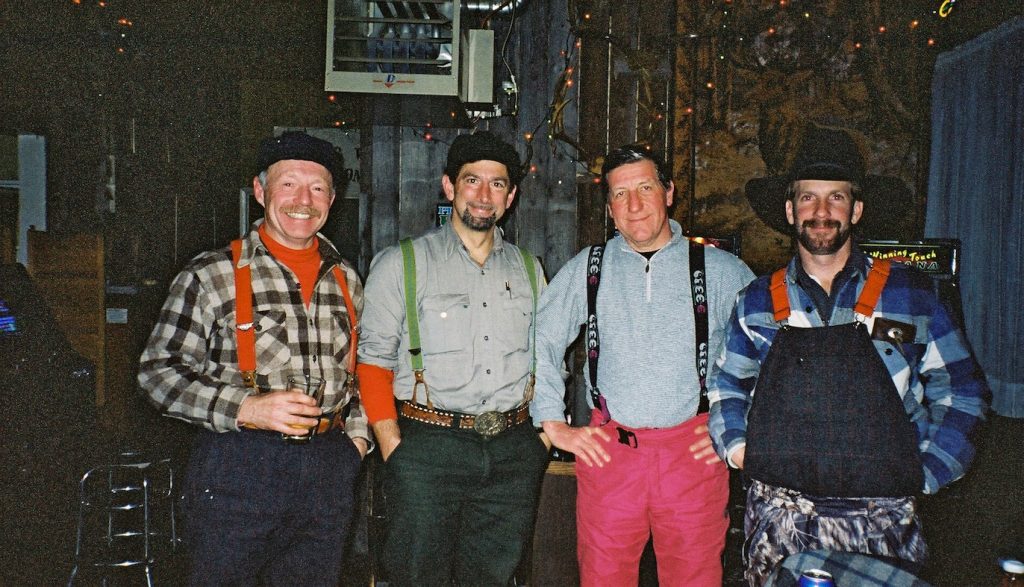
Marc Gauthier, whose pheromone lures have documented the presence of a few cougars in Quebec and New Brunswick, said this in his review on Amazon.ca: “Having tracked cougars myself in this area of Montana and being closely interested in this species, I found this novel by Florian Rochat in the same time realistic, well researched and fascinating. Must be read by all those interested in environmental and conservation issues.”

***

This article was published on the website of the Cougar Rewilding Foundation.

Florian Rochat posted a video of his tracking of cougars in Montana on YouTube.

« Cougar corridor » is available in French as an ebook on Amazon US, on Amazon CA, and on Amazon UK.


Share
Publié dans Archives, Tout le blog | Marqué avec , , , , , , , | Laisser un commentaire

Another connexion with a WW2 pilot

I was in for a surprise recently when I found a very small parcel (perhaps 3×2 inches) in my mailbox. The sending adress carried a name that was familiar to me in Montana. And when I opened up this very light parcel I was really touched and moved by Linda Helding’s attention: she had sent me four small tie and lapel pins, little gold and silver looking planes: P-51 Mustang and P-38 Lightning, two great combat aircraft used by the USA Air Force during WW 2, and another, a postwar one, which I could not identify properly.

These pins belonged to Linda’s father, Arnold Helding, a P-38 pilot who served in Europe, and now I therefore feel connected with him. That’s another connexion with a WW2 American pilot who was indirectly involved in an incident that took place in 1944 in France. In June that year, LeRoy Lutz, who was from Nebraska, got killed in the crash of the plane he was flying, Arnold Helding’s Lucky Lady.

I wrote here about that accident which incited me to write an aviation novel, The Legend of Little Eagle. To my amazement, some time after this book was published, both Linda Helding and Jerry Lutz, LeRoy’s nephew, got in touch (connected) with me. We have become friends on Facebook and chat now and then.

The story of my hero John Philip Garreau has nothing to do with the one of LeRoy Lutz, aside from the fact that they both showed a great altruism and spirit of sacrifice. Which, in Johnny Garreau’s action, saved the life of a whole French family, among them a little girl, the mother of Hélène Marchal, my narrator in the book. Hélène would not have been born had Johnny not acted heroïcally.

In my story, Hélène goes to Montana to research the books she wants to write on First Lieutenant Johnny Gareau. And she meets there with a close friend of his, an old man I purposedly named Harold Holding. Holding gives her his war logbook, and she’s able to quote him to piece together Johnny’s life and actions. One of his last entries is dated in the early days of August, 1944: « Johnny crashed in Burgundy with my Lucky Lady. Of all the rotten… Don’t know what to say. I’m devastated. »

I had not worn a tie for many years, but after receiving Linda’s parcel, I felt compelled to. At least for this picture to show her how grateful I am for her attention.

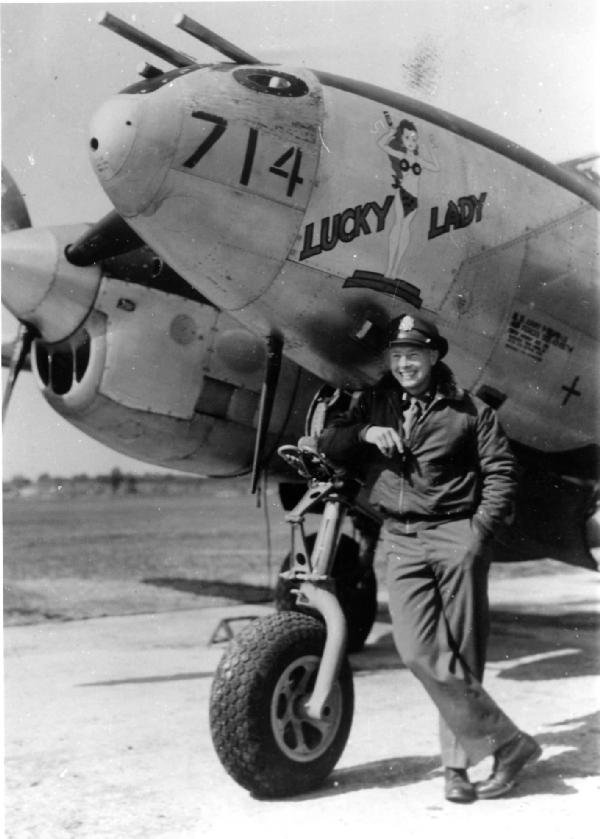
Arnold Helding returned unscathed from his service in Europe in the 479th Fighter Group and enjoyed a long life in Montana, where he died at age 92 in 2007. I’ve always loved this picture of him and his plane.

The Legend of Little Eagle

on Amazon US

on Amazon UK

on Amazon CA

How the story started and how it connected people, in fiction and in real life.

Arnold Helding and his « Lucky Lady ». In 1944 in France, a member of his group, LeRoy Lutz, flew this plane and got hit by the German flack on a mission. He crashed near the little town of Mardeuil in circumstances similar to those of this novel.


Share
Publié dans Archives, The Legend of Little Eagle, Tout le blog | Marqué avec , , , , , , , , , | Laisser un commentaire

A P-51 Mustang for the price of a Beetle (or almost)

I’m not an aviation specialist, not even a real aviation buff, but I’ve come to like planes more than a non-pilot. Unexpected circumstances (the discovery of a letter in a small museum in Montana) have led me to write a novel with a background of aviation and WWII, The Legend of Little Eagle. And I fell in love with the North American P-51 Mustang, model D, which remains nowadays one of the most beautiful fighters ever built. My hero, 18 year old First Lieutenant John Philip Garrau, flies one over Germany and France in 1944. He will have a heroic, tragic fate.

warbirdsheritagefoundation.org

Conceived as a long range fighter, the P-51 D arrived in Europe in March 1944 and played a major role in the subsequent bombing campaigns of the 8th Air Force on Germany (great book here.) It was fast (700 km/h), highly manoeuvrable, with six 12,7 mm. machine guns, and could be equipped with ten 127 mm. rockets (mainly for strafing). More than 8000 51-D were produced in Inglewood (CA) and Dallas (TX) at a price of 50 000 $ per unit.

I don’t know how many of them remain today, but an original Mustang in good condition sells between 1,950 000 and 2,500 000 $. If you ever dreamed to own one but are a bit short of money, a Czech firm offers a nice 70% scale replica for close to 100 000 Euros – excluding taxes.

But there was a time when you could buy an almost brand new P-51 for the price of a Volkswagen Beetle, or close. At the end of the war, the US Army left tons of surplus material of all kinds in Europe. Including several hundreds Mustangs, and several armed forces around the continent and the world went shopping. The Swiss Air Force acquired 130 of them parked in Italy to replace its old, pre-war Messerschmitt Bf 109 and Morane D 3801 at a price of 4000 $ per unit. OK, the greenback exchange rate vs. the Swiss Franc was then worth six times what it is today. But still…

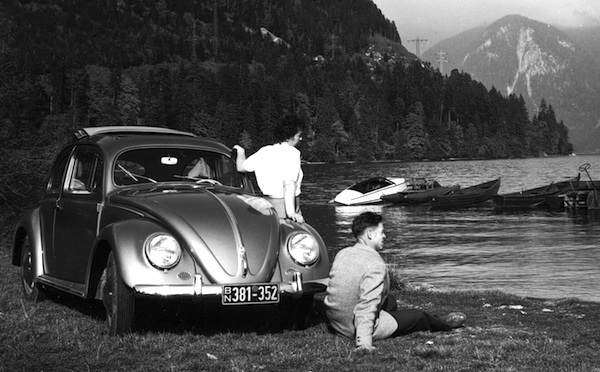
As I was thinking about that the other day, I suddenly remembered a full page ad that Volkswagen ran for a long time in Swiss newspapers (I live in Switzerland): a small, plain picture of its Beetle, and, in very big characters, its price: 5555 SF. That was, I think, around the late 50’s.

www.bestsellincarsblog.com

All right, even though the value of the almighty dollar had began its long and steady slide, the Beetle was actually cheaper than the Mustang. Le dollar and the Swiss franc being roughfly on par today, let’s say that 4000 $ of 1945 could have bought a 25 000 $ Passat today. But many of the P-51 D which had been in service after 1945 and until the mid 50’s were sent to scrap to be replaced by jets. What a waste, would the warbirds lovers of today say ! If only we’d been there. There were bargains to be made.

My first three cars were Beetles. I never dreamed about purchasing a Mustang plane (though I did dream acquiring a Ford Mustang car, oh yes !), even the Czech replica. But I love to watch pictures of Mustangs and read about the famous pilots, aces and heroes who flew them, like Chuck Yeager, and I love those planes better today than the Beetle yesterday.

Florian Rochat is the author of  « The legend of Little Eagle », an aviation /WW2 novel


Share
Publié dans Aviation et pilotes, The Legend of Little Eagle, Tout le blog | Marqué avec , , , , , | Laisser un commentaire